
PHYSICS - Ramps & Hangers (Practice)
OPENING QUESTION: A 2.13 kg block made of oak is placed on a ramp (also made of oak)
The ramp has an angle of 43.7 degrees to the horizontal.
The coefficient of friction for Oak vs Oak is .620
Will the block slide down the ramp?
- Please do a sketch of that situation that accurately shows all forces present-- show that to a partner in your team before you proceed.
- Then do a SOTFA analysis in X (remember, the universe is *tilted*)
- Then do a SOFTA analysis in Y (same notation)
- Then solve!
═══════════════════════════

FORMULAE OBJECTUS:
Newton's Second: F = ma
Newton's Second (weight): w = mg
Newton's First/Second analytics: ∑Fx = max ;∑Fy = may
LEARNING TARGET: I will be able to complete ramp problems with friction during today's class.
WORK O' THE DAY:
We kinda skipped by this yesterday, so let's do a take2:
By the by, be sure to check my STUDY GUIDES page for help with hangers, ramps and elevator problems
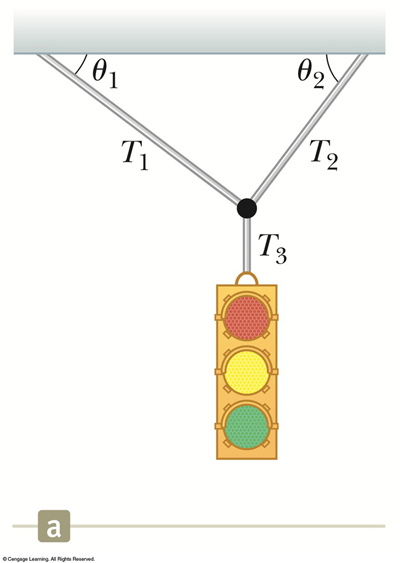 |
If θ2 is 53o, and T2 is 97.50 N, what is the horizontal component of force T2x? What condition(s) MUST be present if T1x = T2x? If the weight of the signal light is greater than T1y + T2y, what MUST occur? What is the value of the vertical component of force exerted by T1? If this signal was hanging on Mars, the supporting ropes would need to support less mass, more mass or the same mass? Would the ropes need to be stronger, could they weaker or should they be the same on Mars? |
═══════════════════════════
Refer back to our opener. What is the largest angle possible where the block would NOT slide?
How fast would an elevator have to accelerate you such that you weight increased by .635?